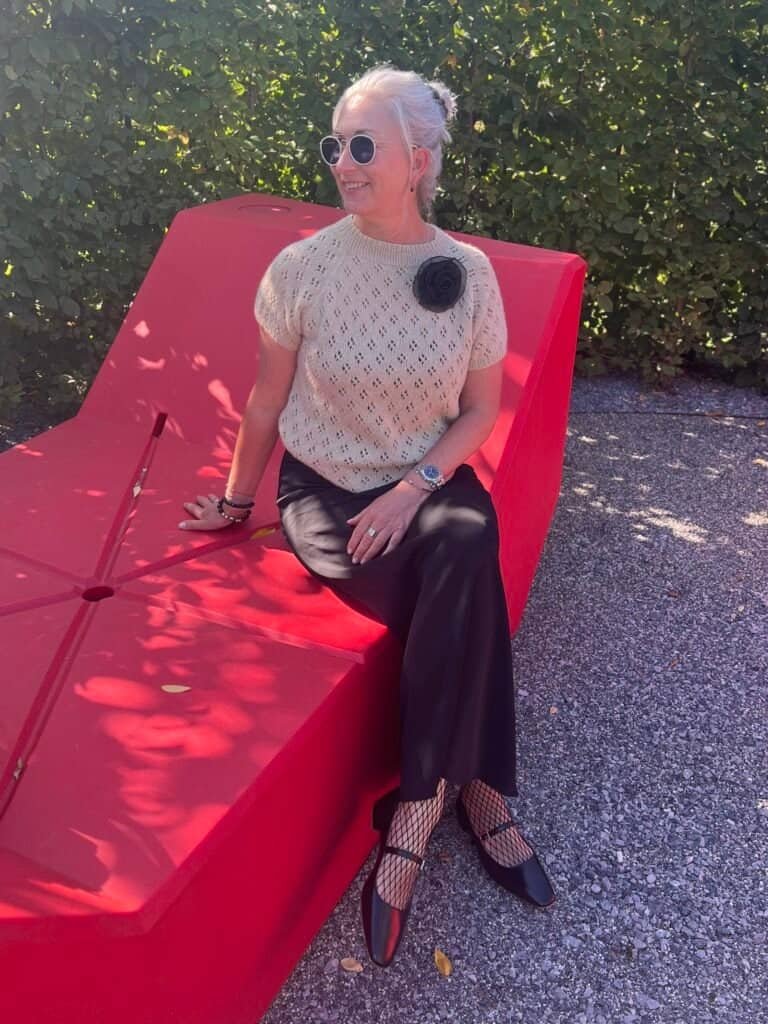
For years, I believed recognition had to be earned.
It was a bitterly cold day in a drafty hall somewhere in rural Upper Bavaria. We had gathered for a team event, and archery was on the agenda. Again.
I had nothing against sports or competition. But at some point I’d had enough of the faster, higher, stronger stories my colleagues traded every Monday morning about their weekends. And of team events that were only ever about competing and winning.
Back then, I was the only woman on a leadership team full of ambitious, extremely athletic men. As a designer from the fashion industry, I was already something of an outsider. My suggestions to add a yoga session or something creative to the program had never met with much enthusiasm.
That day, somewhere between bow and arrow, I’d had it. “Have fun playing Robin Hood. I’m more of a Maid Marian. I’m going to get on my horse, ride back to the house with my veil flowing behind me and have a hot cup of tea by the fire.” Then I turned around and left the gentlemen standing there, speechless.
That’s how I became the Princess.
The Princess Who Wouldn’t Play Along
It wasn’t a big rebellion. And it certainly was not the moment I decided I’d never have to prove myself again. I was still a long way from that.
But I had drawn a line. I no longer wanted to compete in every contest on someone else’s rules. Certainly not in my free time.
At work, things were different. There I wanted recognition – as a leader, as a high performer, as a woman who knew her stuff and got things done. So the Princess was by no means fragile. She rolled up her sleeves, took responsibility, made decisions and delivered results. She just didn’t want to be judged by men’s standards all the time in order to belong.
The title gave me the freedom to be different, and over the years it became something of a trademark. Many of my friends still know me that way, and they always found it amusing that I’d rather be a princess than a queen.
That freedom came at a price. Some people looked at me with respect, some with the suspicion you’d reserve for a strange species, some with mockery. I wanted to belong and still be allowed to be different. A balancing act I didn’t always manage.
Because as much as I fought certain rules of the game, I had long since internalized one of them: Recognition has to be earned.
The Girl At the Dinner Table
Maybe this story started much earlier. At the dinner table of my childhood.
At every meal, I watched my father’s mood. My antennas were always up. A glance, a movement, a change in his voice.
When I spoke my mind, was fully myself or showed something that mattered to me, the mood could shift in an instant. His eyes darkened, his posture stiffened, his voice turned cold. I didn’t know what I had done wrong. We didn’t talk about things like that in our family.
All I felt was that something was wrong. That something was wrong with me.
You can do something wrong without being wrong. No one told me that back then.
How I would have loved to be a princess back then. A little girl who is cherished and doted on. Who has someone in her corner. Who gets to feel loved without having to do anything for it first.
Over time, that longing turned into a particular kind of ambition. Look what I can do. See me. Be proud of me.
I was always curious, creative and ambitious; I loved shaping things and taking on responsibility. All of that is part of me. But early on, a quiet hope joined in: If I just achieve enough, I’ll finally be good enough.
I Was Good at Being Strong
Married young.
A mother.
Divorced.
Off to Latin America as a single working mom with my little boy.
I’ve dared a lot, accomplished a lot and carried a lot. And I’m proud of it. Proud of my courage, my independence and the trust in myself I built while starting my life over, far away from everything familiar.
Later, more roles came along. The career woman. The executive. The partner in a patchwork family. The woman everyone knows will find a solution. What’s for dinner? Where’s my sweater? Has anyone seen the car keys?
The Princess was supposed to free me from exactly that. Still, the questions kept landing in my lap. And most of the time, I had an answer.
I was so good at being strong that for a long time I didn’t notice how much I took it for granted. Until, years later, burnout forced me to take a closer look: at my expectations of myself, at my many roles, and at the question of who I really am when I’m not achieving anything and nobody needs anything from me.
The answer came slowly, over years. Along the way, I uncovered my own identity, layer by layer. Expectations that weren’t mine. Ideas of how a good mother, a successful woman, a loving partner was supposed to be. Some of those beliefs were surprisingly hard to let go of.
Who Am I Without My Title?
One of my most surprising experiences came when I left behind the professional position I had defined myself by for so long. No more impressive business title, no leadership team, no business card explaining who I am and what I can do.
Just Heike.
And then something astonishing happened: nothing.
The people who matter to me didn’t suddenly see me differently. They didn’t value me any less. I don’t have to earn my place all over again. I’m allowed to speak my mind, say no, do things differently. Not everyone likes that. But it’s not on me to please everyone.
I don’t have to prove that I’m someone. I already am someone.
Even without a title. Even without achievements. Even without the next task I handle especially well.
From Princess to Queen
On my 60th birthday, I decided: I don’t want to be a princess anymore. I’m the Queen now. The Queen of My Life.
I still adore the Princess. She stood by me for many years, gave me courage, protected me and, with a healthy dose of humor, helped me find my own way. Her crown suits us both beautifully.
But today I also know: Her title was armor. Armor with a wink, but armor all the same. And beneath it, the girl from the dinner table was still waiting.
The Queen is done waiting. She takes responsibility for her own life, but no longer automatically for everyone else’s. She knows what she wants. Most of the time, anyway. She says yes to herself more often, even when that sometimes means saying no to others. And she has made peace with the fact that not everyone has to understand her choices.
For many years, I factored in other people’s expectations before I even took my own wishes seriously. Today that’s different. Not always, but more and more often.
I write, I develop ideas and I show up with what moves me. Because I enjoy it, because I have something to say, and because I want to live my creativity. And I have nothing to prove with it.
I Still Know That Woman
The former Heike hasn’t disappeared. The one who wants to do everything especially well, who plans, organizes, improves and sometimes starts all over again because it might be just a little bit better. I run into her with every text and every new project. At any moment she can slip into her business blazer, set up an imaginary flip chart and announce: “Okay, now let’s really get on top of this.”
Sometimes I even let her. I like her ambition, her energy and her joy in creating. I don’t want to get rid of her at all. I just don’t want her deciding my worth anymore.
I haven’t stopped setting high standards for myself. I’ve started separating my self-worth from them.
I can feel how much that difference matters right now. Since Paco left us this summer, I’ve had times again when I’m not strong. When I lack energy, life hurts, and I don’t know when I’ll feel solid ground under my feet again.
In the past, I would have made a plan, pulled myself together and kept functioning. Today I also accept the woman who can’t do it all right now. The one who is sad and tired and has no plan. The one who wants to withdraw for a while.
That is the greatest freedom I allow myself these days: not having to be strong all the time. Not even a particularly composed Queen.
And yet sometimes I still hear it, that quiet voice: Is this really enough? Oh yes, I’ve known it for many years. But I don’t have to believe everything it says anymore.
My worth was never up for debate. It never depended on what I achieve.
What I get to choose again and again is to believe that. On good days, on difficult days, and especially on the days when I have nothing to show for myself.
Sometimes I think of the girl at the dinner table. Her antennas always up. That feeling of being wrong. Today I can sit down beside her, take her hand, and whisper what she so desperately needed to hear back then.
You don’t have to do anything to earn it.
You were never wrong for being you.

